Showing posts with label Ingrid Bergman. Show all posts

Sunday, August 14, 2011

Ingrid Bergman, in The Bells of St. Mary's
approximately 61 minutes and 37 seconds
49.5% of the film


The film

At a big city Catholic school, Father O'Malley and Sister Benedict indulge in friendly rivalry, and succeed in extending the school through the gift of a building.

You can read my short review of the film just by clicking HERE.

The film can’t help from being cheesy too often, but I couldn’t have expected differently after seeing Going My Way. The new element to rise the quality of the series is Ingrid Bergman, who’s energetic performance and knock-out final scenes bring more emotion.


Ingrid Bergman as Sister Mary Benedict

Oh, Ingrid, what you do to me, and I haven’t even seen most of your performances. No wonder Joan was nervous on Oscar night: you had the Golden Globe win & the award from the New York film critics! I am picking on Ingrid in a good way, because this is a surprisingly sly performance, she’s so tricky as to take a performance that’s average for 90% of the film and move it into a whole new direction in less than 10 minutes. All the rest of the performance seems like a rehearsal, while she completely has me in some ending scenes that made for the best acting scenes of this field.


Ingrid plays Sister Mary Benedict, the nun in charge of the school Father O’Malley is assigned to. She’s a young nun, very intelligent and wise, strict in many ways, but always up for any kind of well-intended competition. She’s a happy person, very optimistic when it comes to the future of the school, and never hesitating in speaking her mind. It’s a co-starring role that requites lots of smiling, joyous attitude and some fantastic acting abilities for the ending.
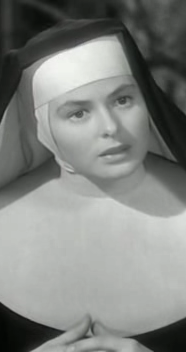
For the most of the film, Ingrid is not required to do much. Her acting is very luminous, very natural and comforting. Her presence on screen is always a joy, and she’s very convincing both as a nun, and as someone who feels friendly and comfortable around children, as a teacher and as a friend. While it’s always good to see her in a scene, there are no big dramatic moments to show real dramatic range.

That is, until the final part. There’s a scene that predicts the greatness to come, when she argues with Father O’Malley on not allowing Patsy, a young girl, to graduate. Her stubbornness is very well acted, and with an innocent guilt, maybe a bit of shame, elements that easily sell the scene. There’s also some singing in Swedish, and Ingrid has a beautiful voice. But what justifies the nomination and the almost-win comes from the very last 2 scenes of the character.


The most touching one is when Sister Mary is praying in the church asking God to remove the bitterness from her heart. I’m trying not to spoil the plot, especially the ending, so I won’t go into story details. The camera is on her for about 3 minutes, and it’s a perfectly believable, fantastically acted scene, all on the face. This is what you call an Oscar scene, and a smart move from the writing part, as you simply cannot take your eyes off Ingrid in this scene. It’s a short one, but so well positioned in the story that it surely becomes the one thing to take away from the film.

Very good acting can also be found in the final dialogue, seconds after the prayer scene, when Sister Benedict has a very emotional dialogue with Bing Crosby’s character (great chemistry between these 2, by the way), with both actors creating a special moment, beautifully acted and giving us through face and words more than the screenplay ever dreamed off.


Had Ingrid not won the previous year for Gaslight, the race might’ve gone differently. It’s not because she’s amazing throughout the film, as I’ve said she’s just a sweet, enjoyable presence for the most part, but the big key dramatic moments are so well positioned, it all wows, and it gives the impression you’ve just seen something very special acting-wise. Only Ingrid can make me switch from an almost-3-stars performance to a solid-4 just by bringing it with a lot of determination in the final 5-7 minutes. So: .


Final conclusions soon to come.

Wednesday, July 14, 2010

Ingrid Bergman, in Autumn Sonata
approximately 52 minutes and 51 seconds***
58.4% of the film


The film

After having neglected her children for many years, world famous pianist Charlotte visits her daughter Eva in her home.

You can read my short review of the film just by clicking HERE.

Even with the long dialogue scenes and the camera work focused mostly on the faces, Autumn Sonata still is one of the most accessible Ingmar Bergman films. The film’s two strong elements are the dialogue (deep and effective) and the acting: a very good performance from Liv and a career best from Ingrid.


Ingrid Bergman as Charlotte

Doesn’t it make you feel good? To see a famous actress, from another movie era taking a role towards the end of her career that suddenly puts her back on the map, for a creating a fabulous performance? You really DON’T see that many good roles for women over 60 (even less nowadays), not to mention leading ones. After an infamous Oscar win 4 years earlier, Ingrid finally got the attention she deserved. It was Casablanca that made her famous and a superstar, but I think it was Autumn Sonata that actually reconfirmed the respect critics and audiences had for this screen legend.

Ingrid plays Charlotte, a famous internationally acclaimed pianist, who comes to visit her eldest daughter Eva (great Liv Ullmann) after many years. In an unexpected turn, she is suddenly confronted with Eva’s repressed feelings towards her mother and the women finally have a real conversation that opens up a lot of trauma from the past. The characters are written to perfection, so all Ingrid has to do is act, and boy does she go there.

Charlotte is a cold, distant woman, but so good at hiding and pretending. Actually, there are more than two layers to this character and it all feels so believable. While Eva seems shy and frail, Charlotte is more of a diva. We can sense her superiority even from the start of the film. Even though I immediately realized she is a cold selfish person (she abandoned her other crippled daughter), Ingrid brings some kind of likeability to Charlotte.


Her monologues are long and difficult, even from the first half of the film and Ingrid understands them and reads them so perfectly (challenging with this complex dialogue), making them her own. I understand where she is going with Charlotte; without saying so, we instantly notice she is not someone who accepts the presence of the weak, not because she is overly cruel, but because she’s so emotionally crippled and self-conscious that she instantly gets disgusted and afraid: just like her attitude towards her sick daughter.

It’s the second part that brings the best acting, just at topics go a bit deeper. Ingrid manages in a fantastic way to slowly peel off Charlotte’s vanity layers, as she is being confronted with the emotional harm she had caused her daughter. Under the mask of a nice person and under the mask of the cold brilliant pianist we discover the empty Charlotte, incapable of loving, scared of losing her talent and fame, guilty for the damage she had caused.

With the help of the fabulous camera work, Ingrid expresses all we need to know about Charlotte, she feels comfortable with the dialogue and you can tell those 40 years of acting experience: when to look, when to react and her ability to create the impression, even if for a short time, of a heartbroken sympathetic Charlotte.


It means a lot to also have a great screenplay. Even if this is an emotional journey for Charlotte, the character is so well built, that in the end I was not sure if she’s changed at all. Both Ingrid and Ingmar go for a very believable take. I myself agree: it’s more believable that she hasn’t evolved and that the whole emotional episode might’ve been exactly that: an episode that came and went, as Charlotte is too incapable of feeling to be able to change. Ingrid easily gives one of the top 5-10 performances this category has even seen. So easy to rate: .


P.S.: There is a scene with Eva playing the piano and Charlotte watching her and listening. She is the genius, her daughter is the clumsy. But Charlotte suddenly gets teary. Do you think she got emotional and proud of Eva or did Chopin remember her of her youth? What do you think? Do you remember the moment?


*** reportedly, the hands playing in the piano scene belonged to Ingmar Bergman’s wife, so in a way it’s a body double; I didn’t count it as screentime if it wasn’t Ingrid’s body part in an obvious way. :)