Saturday, October 29, 2011

Final Conclusions - Best Actress 1985


I have loved The Color Purple for years, so starting Best Actress 1985, I thought Whoopi was gonna be my easy winner. Of course, I was wrong, and that’s why I love my Best Actress series, because the surprises keep on coming. When I started it, I also didn’t suspect 1985 will deliver the worst performance I’ve talked about on the blog so far and the first 1 star I’ve ever given. So it was a year full of surprises, both for me AND for the Academy – Whoopi had a real chance to become to first African American to win this category and it didn’t happen.

Judging by the number of stars I’ve given, no. 1 looks like an easy choice; and it was, in a way. I’ve noticed that those who see the performance are almost entirely charmed by it. no. 2 was also quite easy, given my love for the film and the difficulty of the role. no. 3 is also a performance I respect a lot, in a film whose revisit was completely charming to me. The number of stars is very relevant for the other two performances.

There’s a special award that I’ve included for Best Actress 1945, and continuing it now: Best Acted Scene award, which this time goes to:

Geraldine Page, The Trip to Bountiful – the fantastic scene on the bus, when Carrie Watts confesses about never loving her husband and telling the young woman the story of the man she really loved. It’s an expected, emotional, heartbreaking moment and Geraldine is just devastating in it.


Here is how I’ve appreciated and ranked the performances. If you want to go back and read more, just click on their names:


To say that she is the heart of the film is a huge understatement. She takes the Geraldine-Page-style-of-acting to levels she’s never gone before by bringing incredible kindness, believability and life into such an emotionally-rich character. There’s no false note here, just a legendary actress doing her best work: a performance both entertaining and surprisingly heartbreaking.

the highlight: Her confession about not loving her husband.


It’s a performance that feels complete only after seeing it a couple of times. What I loved the most about it is the deep understanding of what Celie feels, always giving us the impression of a beautiful person hidden somewhere beneath fear and humility. Whoopi carefully follows the evolution of the character, building a believable emotional transformation.

the highlight: The dinner scene, when she finally speaks up.


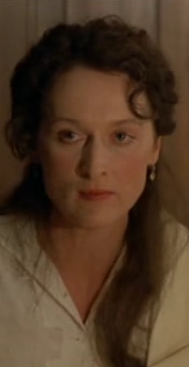
Meryl is so pretty in this I would’ve forgiven her anything. But as expected, to me there are no mistakes in this performance: I liked the accent and I loved that she made it look natural and simple… and even easy. It might not seem like a very challenging role, but that’s because Meryl is acting like a pro, making wise decisions when to act more and when to just sit pretty.

the highlight: for me, it has to be the voice-over that starts the film.


I have confessed in the profile that I think Jessica Lange was way to sensual and sexy and gorgeous to take on such a role. I didn’t buy her as Patsy Cline and that Southern accent didn’t help either. But with all that against her, plus a terrible screenplay, her performance has two highlights: the emotions she tries to bring in the lip-synching scenes and the few scenes of more emotional depth.

the highlight: taking off the bandages after the car accident.


Officially, the worst performance of the ones I’ve reviewed so far in the past 2 years. The role is incredibly juicy, but Bancroft has no idea what to do with it. Not only does she not do it justice, she sinks it, making it the most annoying character in a poorly made film. It’s a completely unbalanced performance, surprising only by the complete lack of inspiration in Anne’s acting choices.

the highlight: none.


Time to play the guessing game of who got more votes. I still believe Whoopi was a favorite before the final verdict, because of the Golden Globe support, and also because they had all seen Color Purple. However, how would they deny a win for Geraldine Page, considering it was her 8th(!!!) nomination and she had never won. I agree with the Academy’s choice, which was partly honorary, partly based on the actual performance – but it sure wasn’t an easy victory to get. I’m quite sure Whoopi was a close 2nd, but this only because Meryl already had 2 Oscars. I think Meryl was 3rd; she was a threat considering her film ended up becoming the Best Picture winner. Jessica was probably 4th, though not a big threat, and Anne Bancroft 5th, as I like to believe extremely few voters would’ve given her the win.

To see other BEST ACTRESS years discussed so far, go to the column on the right.


What’s next: I have already held the draw on Twitter, before I left for Athens, for the next Best Actress year, from the 1930s. The year that won was 1931 (the one with Marie Dressler). I will make the official announcement soon.


Saturday, October 22, 2011

Whoopi Goldberg, in The Color Purple
approximately 58 minutes and 38 seconds
39.5% of the film


The film

The life and trials of a young African American woman.

You can read my short review of the film just by clicking HERE.

I’ve really liked the film ever since I first saw it, about 10 years ago. While my love for it isn’t as obsessive as it was back then, I still think it’s a wonderful drama, with a very emotional well-told story. The performances are terrific, most of them coming from actors without experience who offer career-best acting.


Whoopi Goldberg as Celie Johnson


Every article on impressive first-performances must include Whoopi Goldberg’s in The Color Purple. I think she was a comedienne by then, but this was her film debut, and it justifiably took Hollywood & the rest of the world by surprise. And this even more considering the difficult character she had to play, in a purely serious drama. Had she won Best Actress back then, she would’ve made history as the first African-American to do so. But what she did gain from it was a fantastic start of a very popular career.


Whoopi plays grown-up Celie, a young woman abused by her stepfather and sold for marriage to an even more abusive man, who forbids Celie from seeing her sister, the only person who’s ever loved her. The constant abuse turns Celie into a very humble person, who never dares to speak up. The unexpected presence of Shug Avery, the free-spirited mistress of her husband, brings a bit of hope into her life.

We don’t see Whoopi for the first 35 minutes of the film, but when she shows up it really changes everything, and finally we get to see something interesting and intriguing in Celie. Even so, I admit to have had some difficulty adjusting to the introductory shyness of the performance – but once I’ve finished the film, it felt complete and I realized the journey that the performance itself is.

And I see it now it couldn’t have been done differently, given the character and its emotional frailty. Though not the most exciting thing to watch, the quiet, shy, child-like Celie is what makes sense in the context of the film and Whoopi gets it right – her gestures and voice-acting, though not always perfect, leave the impression of a traumatized person, but also of a beautiful spirit hidden behind the robotic-behaviour of an abused person tragically finding normalcy in such a lifestyle.


It’s not a performance easy to judge, because it’s not flashy, but not subtle either. It’s a performance very dependent on the trajectory of the character, living little space for the actress to diversify. The character changes a lot during the film, both physically and emotionally, and Whoopi has to keep up by making the change visible, believable, in the spirit of the character.

Of course, I preferred the scenes from the second part, and the table scene is Whoopi’s great triumph, portraying Celie in a moment of her life when she’s had enough. She’s wants to get away regardless of the price and I felt for her more than in any other scene: the difficulty of having to speak up and confronting her abusive husband. You can feel how nervous she is with the perspective of finally letting all that hate out. Whoopi is fantastic in the scene, superbly demonstrating the emotional struggles of Celie.


It’s not a traditional character for this category, and I somehow feel it’s a performance hard to agree on, especially among bloggers. What makes even the performance a little unusual is that most of the emotions of the character are shut inside for at least half of the screentime; while staying faithful to the character, for a big part of it it seems like Whoopi is not doing enough, reacting too little. To me, that’s just being devoted to your character; sure, I prefer louder, more open performances, but I completely respect this one. I’ll go with a very strong .


Final verdict coming probably tomorrow.

Saturday, October 08, 2011

Jessica Lange, in Sweet Dreams
approximately 79 minutes and 30 seconds
71% of the film


The film

Lange portrays Patsy Cline, the velvet-voiced country singer who died in a tragic plane crash.

You can read my short review of the film just by clicking HERE.

No, I’m no fan of this film; even if I’d agree with the focus put on the relationship between Patsy & her husband, I still don’t like the way it’s done. The writing is bad, at one point even trying to justify his abusive behaviour. It should’ve been more about her love for music & her songs, and less about domestic violence.


Jessica Lange as Patsy Cline


It needs to be said that any Jessica Lange fan would probably rate this 3 stars or higher! It’s not that I dislike her, I’m actually quite inlove with her as a person & movie star & gorgeous woman, but I believe that her sensuality, her sexiness is so powerful that it often limits the area of roles that would fit her. Sometimes she’s perfectly cast, other times not so much… I think Jessica’s charm is so distinctive, especially in her younger years, that it makes it hard for her to sell some of the roles, let alone a biopic performance of legendary country singer Patsy Cline.


Jessica plays Patsy Cline, country music superstar, from her early days of anonymity to her successful years, up to her tragic death. The film is mostly focused on her relationship with her abusive husband and their bumpy love story. The role makes room for enough loud scenes & shouting, but such moments of domestic trouble weren’t so interesting to me. As for the scenes with singing, her lip-sync is… just ok; not the worst, but you could easily notice the difference.

As you can tell, my biggest trouble with this performance is that I didn’t see Patsy in it. Jessica surely tries and she is most effective in the quieter scenes, like the ones after the car accident or any other time when she gets to reflect on what’s happening around her. Sometimes, she fails: her loud southern style is unconvincing and often feels unnatural, as if she was trying just a bit too hard. Also, her scenes as younger Patsy are the weakest.


A good screenplay might’ve made the difference and would’ve allowed Jessica, if not to convince me this is biopic, at least to put in some depth into the character. However, as it is, the writing is very lazy, sometimes giving way too much explained emotion into the dialogue, when we should’ve actually seen that through Jessica’s acting. I didn’t feel a connection to the character, because most of it is laid just on the surface… Could Jessica have done better with an ok screenplay? Hard to say. What I do know is that I had almost no idea who Patsy was, other that some loud, abused wife.

And you know I cannot not mention that Meryl was up for this role and didn’t get it… While it doesn’t affect my judgment of Jessica’s performance, I suspect Meryl would’ve been more convincing even just by letting sensuality behind and losing herself in the character… Because Jessica’s performance has a bit too much sassiness in my opinion and not enough real emotion spread throughout the film.


Jessica is good, she’s ok, she’s gorgeous in the second half, but not convincing to me. And while I’ve clearly underlined the failure of the screenplay and the direction also is messy as hell, this shouldn’t influence my perception of the final result. Truth is, to me it’s an unsatisfying, incomplete performance; while I considered at one point to give it more, I must go with a strong . But seriously: love you, Jessica! It just wasn’t the role for you, also not the screenplay.

Friday, September 30, 2011


I wish I had more time to write more about dear Deborah Kerr, who would’ve turned 90 today… I said I was gonna post about her, and I’m keeping my promise by remembering a bit her Heaven Knows Mr. Allison performance.


While I’m not one of her most devoted admirers, and I still have plenty performances of hers to see, I surely think she hold her own place in film history and in Hollywood history, by inspiring a certain style: beautiful, delicate, sometimes mother-like figure, very elegant, and a lady to be respected, if there ever was one. She seemed to have lived her career with a lot of class, probably her most distinctive quality.


And it might be just the right time to throw in a fragment from my profile of Deborah Kerr in Heaven Knows Mr. Allison:

…Then it’s time for her acting skills to inject intelligence & emotion in this otherwise dull-written character. The result is a believable Sister Angela and although the performance doesn’t steal the show, it’s great subtle work. I also suspect it’s that type of actress-magic performance that grows with time. I truly believe Deborah had fun with it; a relaxed performance I have most respect for.


Happy Birthday, Deborah!


For more on this blogathon, go to Waitin’ on a Sunny Day, where Sophie is the expert.

Monday, September 26, 2011

Hello.

I haven't posted in a week or so (or is it 2?) because I'm in Athens with work, lots'a of work I mean. I also have that annoying tonsillitis (3rd this year!!) with high fever and everything wrong, so that killed a big part of my mood for the past 2 days.

But I'm not taking a break from blogging, no way. I hope to feel better and have Jessica Lange's Sweet Dreams post ready this weekend.

Also, this Friday there's the Deborah Kerr blogathon I signed to. I'll probably show up here with a post on that.


In the meantime, I'm quite active on twitter, my account being @AlexInMovieland


To learn more about the Deborah Kerr blogathon, click HERE.


See ya.

Thursday, September 15, 2011

Meryl Streep, in Out of Africa
approximately 100 minutes and 51 seconds*
66.7% of the film


The film

In 20th century colonial Kenya, a Danish baroness/plantation owner has a passionate but ultimately doomed love affair with a free-sprited hunter.

You can read my short review of the film just by clicking HERE.

It’s a film I like, because it’s so pretty and relaxing, a simple but interesting story to watch. The actors are fine, the direction is beautiful, the cinematography is dreamy and the original score is perfection, magic to my ears. And what a start for the film… Memorable.


Meryl Streep as Baroness Karen von Blixen-Finecke


Meryl will benefit from a lot of things while I write this, mostly generosity, because how can one really resist her charms, even when she’s not even trying… I favour her because she’s probably in my Top 3 favorite actresses, because she is so impressive & intimidating in her Oscar record and because I like Out of Africa quite a lot. And look at the screentime, there’s plenty of Meryl in it, and even more than the numbers would suggest.


Meryl plays Baroness Karen Blixen, a Danish woman who impulsively marries a man she doesn’t love, for his title, to spite her lover & looking for an adventure. They settle in Africa just before WWI and they keep a farm. As she becomes more disappointed with the marriage, she starts an affair with a very free-spirited huntsman. The film is all about her, and while she doesn’t get to cry or scream, it’s quite an emotional role.

As I said, this is not a flashy role, even though there could’ve been opportunities. This might be because the film is so quiet, there’s a certain tranquillity to it, so any unexpected burst of tears & shouting would’ve damaged the balance. In many ways, I appreciate that, it’s like a small sacrifice Meryl has to do, settling for a less demanding, more subtle part. By keeping it natural and flowy, she makes it look so damn easy.


Thankfully, I’ve seen it 3 times now, and I could tell this wasn’t as plain as some might find it. I was ok with the accent and I admire Meryl’s love for the camera and the camera’s love for Meryl, how she gives the right look, the right expression, the right body movement at the right point. She’s delicate, feminine but strong in that feminist way, and as always gave me the impression of a deep understanding of the character.

She’s rarely been so beautiful in a mature way, and brings something warm and likeable to Karen, something any central character should have. And she manages to keep the likeability even in such scenes at the end where Karen is jealous and possessive. With the help of good a screenplay, she keeps it human, playing it in a subtle way, as if arguing in favour of her character’s constant need for possession and security.


It’s certainly not the most challenging role she’s ever had to play, but she is the one mostly carrying the film. While she rarely gets a more volcanic scene, she’s constantly great throughout, slowly building a character that’s both convincing & likeable, even when not hiding from showing us Karen’s flaws. It looks easy because it’s Meryl doing it, and good acting from Meryl definitely gets a from me.


***the screentime was difficult to count, because of the voice-overs and mostly because of shots from long distance, where I wasn’t sure if a body double was used. I expected more screentime, as she is in almost every scene; however, in dialogues, the camera is not always on her, which takes away from the overall screentime.

Sunday, September 04, 2011

Anne Bancroft, in Agnes of God
approximately 31 minutes and 17 seconds
33% of the film


The film

When a naive novice nun is discovered with a dead newborn in her conventquarters, a court appointed psychiatrist investigates her case.

You can read my short review of the film just by clicking HERE.

A mess of a film, with overall uninspired writing, terrible dialogue and ridiculous screenplay solutions. Most of the performances are all over the place, and it sure lacks some strong directorial guidance.


Anne Bancroft as Mother Miriam Ruth


I’m gonna change a bit the regular structure of my Best Actress profiles, as I’ll give the rating right now, in the first paragraph. To justify it, I’ll keep it short. From the 90-something Best Actress performances I got to write about so far, THIS is the worst. Elizabeth Taylor, at least, had some insanity spark going on and nailed the bitchiness in Raintree County. Vanessa Redgrave had nothing to do in Morgan!, but at least she was charming enough to barely make it watchable and almost funny. These ladies had SO few to work with. I have nothing against Anne Bancroft’s acting in general, but when you get a juicy dramatic role and fill it with the most uninspired, awful acting choices, without any understanding of the character or sense of direction… then I have to call you out for this. It’s the first time I’m using this rating, as it’s undoubtedly the WORST performance I’ve written about since starting the series. So, Anne, it’s a .


Anne plays Mother Miriam Ruth, the Mother Superior at a Canadian Convent. When one of her nuns kills her newborn, she tries her best to protect the young woman, while also having to deal with a very persistent psychiatrist, willing to find out the whole truth. Sure, the dialogue in the film is messy, but otherwise it should be

the most interesting character in the film, as she is, in some measure, the puppet-master. The unfortunate result: the most boring, confusing performance.

Both times I saw it I tried to figure out what was wrong with the performance, why isn’t it glued at all, what is Anne trying to tell us… My conclusion is that she isn’t telling us anything, she’s just terribly confused, changing the character’s attitude from one scene to another, sometimes from one line to another, without making it cohesive or even define it as a characteristic of Mother Miriam.


The role was created on stage by Geraldine Page, and I don’t even wanna imagine what such a

creative actress might’ve done with it. It’s a role that allows the actress to play around, and it could work so easily IF you make up your mind on how to act it. Bancroft goes for nun-next-door, creating a character that’s neither smart, nor funny, even though the dialogue wants us to believe that. She goes for a type of character that cracks jokes, tries to be funny, keeps a surprised dumb look on her face and ultimately creates the dullest character in the film.

There’s one scene where she rushes into the psychiatrist’s office, with some energy and fury, and it’s maybe the one decent acting moment because she manages the shouting, but all this with the help of the editing and very often cuts to Jane Fonda. Beyond that there’s nothing but confusion, lazy acting, uninspired line readings, failure to express real emotion or to explore the potential of the character.


There was no acting plan to this performance, no perspective, no angle, just poor, very poor choices. When an actor manages to sink the character even lower than the screenplay had planned for it, than I’m just fine with my 1 star rating. Giving it anything more than that wouldn’t be fair to all those ok performances that received 2 stars from me.

Sunday, August 28, 2011

Geraldine Page, in The Trip to Bountiful
approximately 72 minutes and 44 seconds
69.3% of the film


The film

Set in the 1940s, it tells the story of an elderly woman, Carrie Watts, who wants to return home to the small town where she grew up.

You can read my short review of the film just by clicking HERE.

It wouldn’t be much of a film without Geraldine Page in it. The supporting actors deliver boring, uninspired performances, the screenplay loses its track towards the ending, so it’s up to Geraldine to pick up the pieces. Should only be recommended as a study of master class performance.


Geraldine Page as Carrie Watts

When remembering great actress from the old days, not enough people mention Geraldine Page, who seems to have had a great career in theatre and definitely a splendid one on screen. Just by looking at her Oscar nominated roles you can see some incredible diversity in the roles played. She received her 8th Oscar nomination for The Trip to Bountiful, 32 years after the first one, and her final nomination as she died in 1987. It’s a fantastic performance to end an impressive career.


Geraldine plays Carrie Watts, a widow living with her son and a very dislikeable daughter-in-law in a small apartment in Houston. She has a very cheerful, lively personality and all she dreams of is to escape that place and go back to her home town of Bountiful, to her house that she hasn’t seen in 20 years. She manages to get away and sets on a trip that will bring back a lot of memories from the past. It’s a very dramatic role, not so much in the actual writing, but in the opportunity it gives Geraldine to bring her A-game.

When I first saw it a couple of days ago, I was a bit frustrated with the film and especially the story. First, to get it out of the way, I think it’s an EXCELLENT performance. But it annoyed me that the screenplay didn’t give us the ending that we, and Geraldine, deserved. The performance and the story build a lot towards her getting to Bountiful, but those last 30 minutes are probably the most ignorable scenes Geraldine has to do. Maybe she knew that, that’s why she prepared the big punches from the first half of the film.


Words cannot describe the acting experience that can be found in this performance. I’ve noticed it even more the second time I saw it. Geraldine takes an old lady character and completely brings it to life, creating such a relatable likeable person that I rooted for the whole film. Difficult dialogue never stops her, and the overreacting, worrying, maternal feeling, resignation – all these are beautifully shown in the performance. When the camera is on her face with her delivering some short monologue, that’s very close to acting perfection.

Every gesture is perfectly calculated but so well delivered it comes off as the most natural thing, so recognizable, so fit for this character. Geraldine makes it become not just a film about a trip, but a film in which you can easily tell the backstory of the character, the rich emotional life this woman has lived, the drama of getting old and losing those around you. I can write so much about it, but if you’ve seen it, you know what I mean.

Her best acting moment is in the bus scenes and a particular one is truly heartbreaking. If you’ve seen it, you might remember her confessing to the young woman that she never loved her husband. The pain of the character while remembering the emotional suffering is so brilliantly played it’s definitely hard to forget.


What disappoints me the most about the film is that it doesn’t give her the possibility to deliver an ever more sensational ending, as I knew she had it in her to blow us away with those scenes in the house. Had the last 30 minutes of the film focused entirely on her character and her emotions, we would’ve witnessed something of Ingrid Bergman in Autumn Sonata calibre. Even so, she manages to give so much with not enough support and it’s one of the best wins this category’s ever had.

for sure. How difficult it will be for me to pick a winner for 1985, as I rarely get this excited (notice I wrote more that usual, and I had to hold back). Loved it.